
BY Raquela Delgado-Valentín, María Fund, and Victor García The James Irvine Foundation
At the beginning of 2025 we had every indication that the current challenging chapter across the nation and around the world would deepen to a magnitude we had not experienced before. We knew, however, that in our own lives and as professionals working in philanthropy, we were committed to centering the needs of communities who have always been excluded, othered and kept at the margins of societies.
Because historical moments like the one we are living through also call upon us to find our colleagues who are equally committed to pushing toward greater equity and life opportunities for vulnerable communities, we knew we had to organize ourselves as grantmakers in new ways to meet the moment.
Fortunately, we had learned about the PLACES Fellowship and participated in what turned out to be a transformative life experience for us among a cohort of 16 grantmakers. While each of us lives in and serves communities thousands of miles apart from one another (one of us is in California and the other in Puerto Rico), we recognized as we began our participation in PLACES that the communities we serve face many similar social and economic disparities in our respective regions.
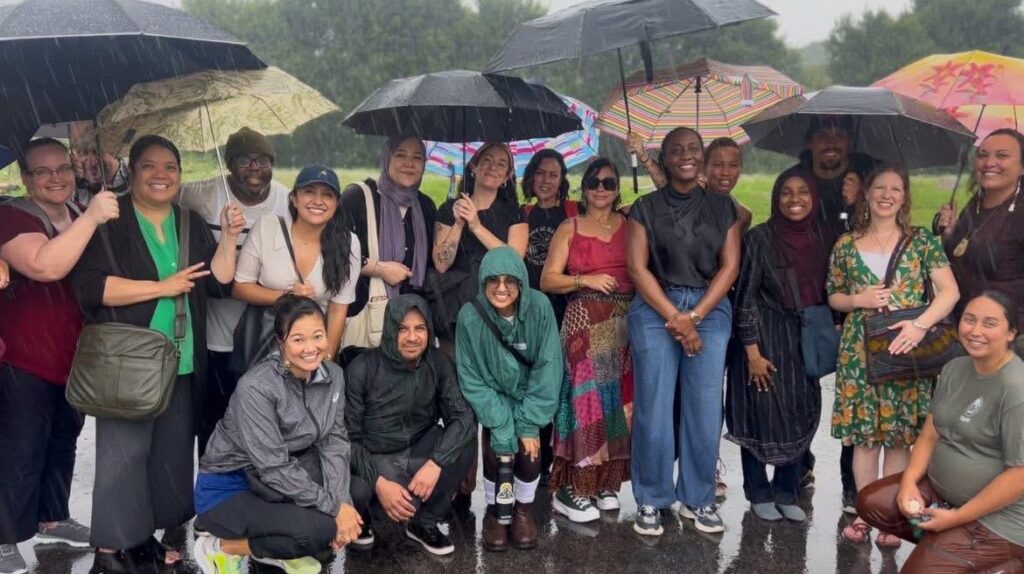
Our cohort in Nashville, TN!
Knowing this, the PLACES Fellowship curriculum invited us to explore the intersections of structural racism, community empowerment and equitable grantmaking practices. Throughout our year-long experience in PLACES, we met fellow grantmakers in Syracuse, NY, Minneapolis/St. Paul, MN, Nashville, TN and Tucson, AZ, who shared how they too are collaborating with and funding community partners to address the impacts of intersecting issues such as economic inequality, the effects of climate change, immigration policy, anti-LGBTQIA+ measures, limited access to housing and land, among other timely issues.
Our final site visit with the Fellowship was in Tucson where we learned from the Community Foundation for Southern Arizona about their Environmental Sustainability Impact Fund. Their work is anchored on preserving, protecting and restoring the local environment while supporting greater awareness and education about our planet. We heard how critically important it is for community initiatives to incorporate the voices of youth as well as indigenous perspectives and practices into program design. We also heard from implementers of the Foundation’s LGBTQ+ Alliance Fund and their grantee partners. Their initiatives benefit the LGBTQ+ community, including elders in the community who for a number of reasons do not always have familial support or access to safety net programs.
Our time in Tucson seemed to go so quickly and made us nostalgic. It felt like that final day of class and we knew it would likely be a long time before we saw our new friends and colleagues in-person again. A “heart-blowing” yoga exercise through somatic release, mindfulness and sound healing helped us to be in the moment and reflect on what a powerful learning experience we had just been through together.
The closeout to the Fellowship began with share-outs about key learnings that had stood out to each of us. Some of us uplifted the importance of standing in solidarity with each other and our communities, as well as the importance of centering our shared humanity. Individual capstone projects took the form of beautiful photo collages, inspiring poems, heartfelt spoken reflections, paintings, multi-media timeline visuals and other innovative forms.
Overall, the PLACES Fellowship experience helped us confirm our resolve to ensure that the local communities we serve can access resources to build power, and secondly to ensure that as practitioners in philanthropy we continue to organize ourselves toward evolving the sector toward an approach that increasingly centers local communities.
The reality is philanthropy is not neutral — it is deeply embedded within systems of oppression and has also been used as a tool for repression. But we can change that. From the past years working in philanthropy, we recognize that there are other ways of doing this work. In these site visits we have reaffirmed that philanthropy must promote inclusive and centered values in the praxis and has to be aligned with liberation — that includes decolonization.
Deep listening and authentic trust-building must be integrated into the principles of philanthropy and resources should be determined by the most impacted people. To do this work we must also center love. Work for social justice is born from a deep love for our communities and for humanity. It is also born from pain, trauma and injustice; feelings that manifest themselves in complex ways.
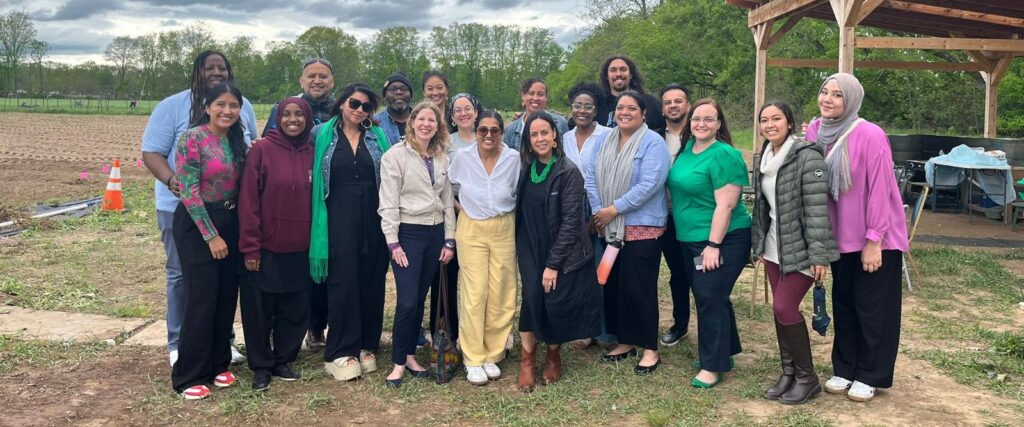
Our cohort in Syracuse, NY!
We know the system is not broken. It works as it was designed to work and keep communities oppressed. But our desire for change allows us to do the impossible for our collective liberation. In this moment and in this sector, we have an opportunity to be changemakers. We share a personal commitment to equity, and we also recognize that if philanthropic institutions do not evolve and center the communities they claim to support, then they will be complicit with that system. We recognize philanthropy as a path to moving resources, centering power on the people, knowing that we can support these processes but are not the ones who lead the transformation that is needed to live in a just society.
All human beings have the right to fair and equal access to the use, control and benefit of the same goods and services in society. We all deserve to “Vivir Sabroso”. That means that Dignity is the central goal in the struggle for a good life. Until dignity becomes the norm.
About the Authors

Raquela Delgado-Valentín (ella/elle) is the Resource Mobilization Director for María Fund, Puerto Rico. She holds a Doctorate in Social Work with a specialization in Administration and Social Policy from the University of Puerto Rico at Río Piedras. Her political awakening began with her first arrest during the struggle to stop the U.S. Navy’s bombing of Vieques in 2001. Since then, her commitment defending social justice, equity, inclusion, human rights and freedom, has remained unwavering. She believes in a a free Puerto Rico where we all can live with dignity. She was also a member of TFN’s 2025 PLACES Cohort.
 Victor Garcia is Program Officer on the Priority Communities initiative at The James Irvine Foundation, whose singular goal is a California where all low-income workers have the power to advance economically. Victor has more than 20 years of experience in program strategy development and implementation of grantmaking across California. Throughout his career, he has led projects and initiatives to facilitate access to greater life opportunities for first-generation college students, workers who earn low wages, and rural communities. He has also worked to increase the strategic capacity of post-secondary institutions and nonprofits to better serve diverse populations. Victor holds an EdD from the University of Southern California, a Master of Public Administration from CSU Long Beach, and a Bachelor of Arts degree in History from the University of California, Santa Cruz. He was also a member of TFN’s 2025 PLACES Cohort.