
BY Tere Figueras Negrete, TFN Senior Communications Director
Welcome to Know Your Network, TFN’s blog series highlighting the people making an impact across our community of funders, partners and allies — and beyond.
For this installment of KYN, we invited Maggie Rwakazina, co-chair of TFN’s Urban Water Funders working group and until recently a program officer for Spring Point Partners, to share her insights on the importance of advancing water equity, advice for new funders — and where she’s finding moments of joy and purpose in these challenging times.
Q: Maggie, we know you through your very active role with TFN’s Urban Water Funders working group, which explores urban water solutions like green stormwater infrastructure and climate resilient strategies — with a strong focus on water equity and vulnerable communities. But you have a long professional history working on water issues even before becoming a funder. Tell us a little bit about your connection to water? What is it about this issue that has inspired or shaped so much of your career?
A: Water is central to each aspect of our life. I’ve studied water since I was a young girl growing up along a tributary of the Allegheny River, known for its biodiversity and water quality. When I moved to Philadelphia to seek a more metropolitan lifestyle, I found not everyone had access to the high-quality water resources of my childhood. My time at Philadelphia Water Department and other public sector agencies gave me an inside view of water governance systems. Working in philanthropy, I’ve had the opportunity to support the leaders and organizations shifting these governance systems and building trusted partnerships between community organizations across that inside/outside divide.
Q: Most people turn on their taps and don’t think about the many workers behind the scenes who keep our water infrastructure running. At Spring Point Partners, your funding focus included supporting partners working toward equity in water utilities. What are the critical issues facing water utilities at the moment?
Water Utilities are funded almost exclusively by their ratepayers with little to no state and federal funding. Since they are providing our most essential public infrastructure service, they tend to be fairly risk-averse in culture. Most utilities provide the most affordable and highest quality drinking water, some don’t or can’t, and it’s difficult for people to know fully know the safety of their water without testing or some level of trusted relationship.
Given the general breakdown of trust in public institutions, water utilities face many challenges that the sector’s traditional focus on engineering, science and fiscal management is not equipped to solve on its own. Utility leaders are eager to build new skills within their workforce and build deep collaborative partnerships with their community leaders.
This is why my work at Spring Point Partners focused on supporting the next generation of public water leaders who better represent and reflect the communities they serve. This included leadership development training for thousands of utility leaders across the country, peer networks of leaders, amplifying, and recognizing under representative leaders — changing the face of what water leadership looks like today, and supporting the favorable conditions and culture change work happening within municipal water agencies. Investing in leadership is an important lever for systems change, especially at a time when local governments are faced with a massive wave of retirements. This work helps change out the people who make up “the system,” bringing in new voices and elevating those with closest proximity to their community at the decision-making table behind closed doors within our public agencies.
Community non-profit organizations also engage in this work and partner with water utilities, playing a critical role in building trusted partnerships to bridge the trust gap. There are great examples of deep collaborative partnerships that have formed when leaders of community-based organizations and utilities work together to advance water democracy in their communities. Take a look at Junction Coalition in Toledo, Ohio, or the cross-sector collaborative Jersey Water Works. These are examples of the important work required to rebuild the fabric of our society and the institutions managing our critical infrastructure.
At a moment when many issues seem overwhelming, this deep systems change work requires funding leaders who are ready to take action at all levels to advance equity within local public institutions, build the capacity of community based organizations, and support national NGOs to provide technical assistance and frameworks.
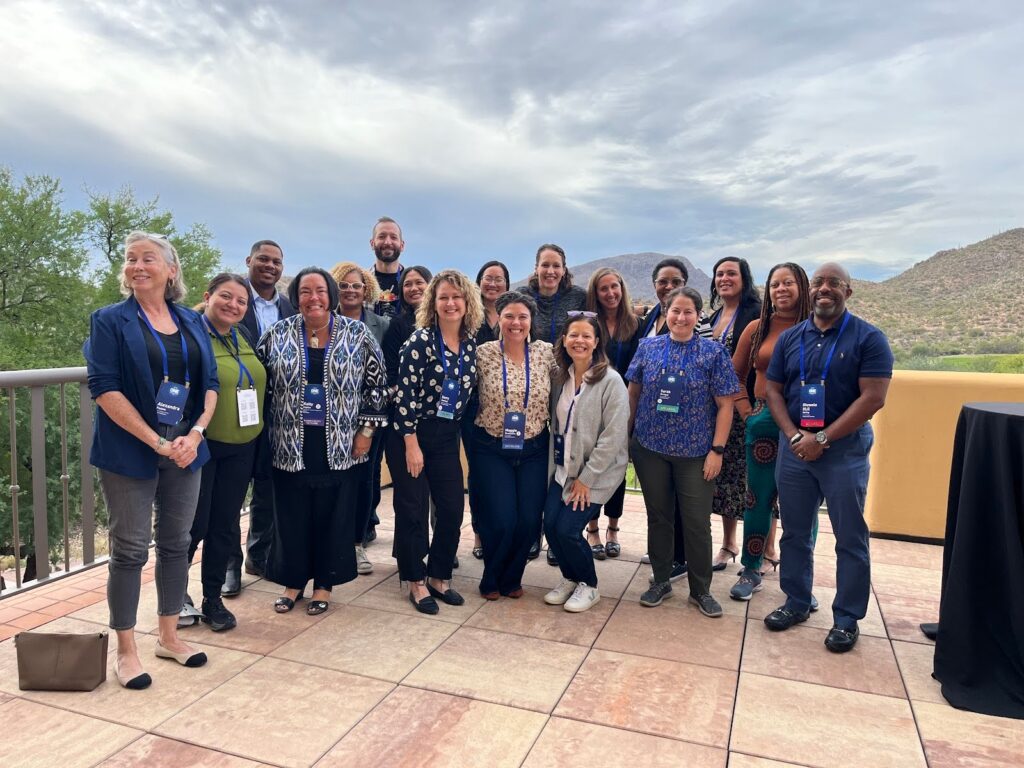
Urban Water Funders and progressive water utility executives at the UWF-WALA breakfast, One Water Summit, November 2023.
Q: How would you describe your relationship with your grantees? Can you share a grantee story or project you’ve found especially impactful?
A: I saw my role as program officer as both a partner and ally to my grantee partners doing the work. When I began my role at Spring Point Partners in March of 2020, it took time to build trust with my partners but I made an effort to meet them literally where they were — on the conference circuit, and to show up for them in any way I could. I believe most came to see me as a true partner in the work during my five years as program officer.
I knew early on that this funding would only be for five years, so I focused most of my energy on community building and creating space for our partners to develop trusted relationships with each other. We gathered virtually and in person to help facilitate peer learning and guidance. In May of 2022 at an in-person gathering, the group really found their collective identity after a short mapping exercise where we provided the space to co-create an image of their individual and collective impact. Using a tree as a symbol, each organization was asked to put their own leaf on as many of the branches (representing parts of the funding strategy). This past July, we gathered for the last time as a group at the One Water Summit where the partners led sessions and invited others into their community supporting water leadership. They even re-created a new 3-D tree, representing their desire to continue this community and work beyond Spring Point Partners funding and convening. I thought that was symbolic of the power of community building!
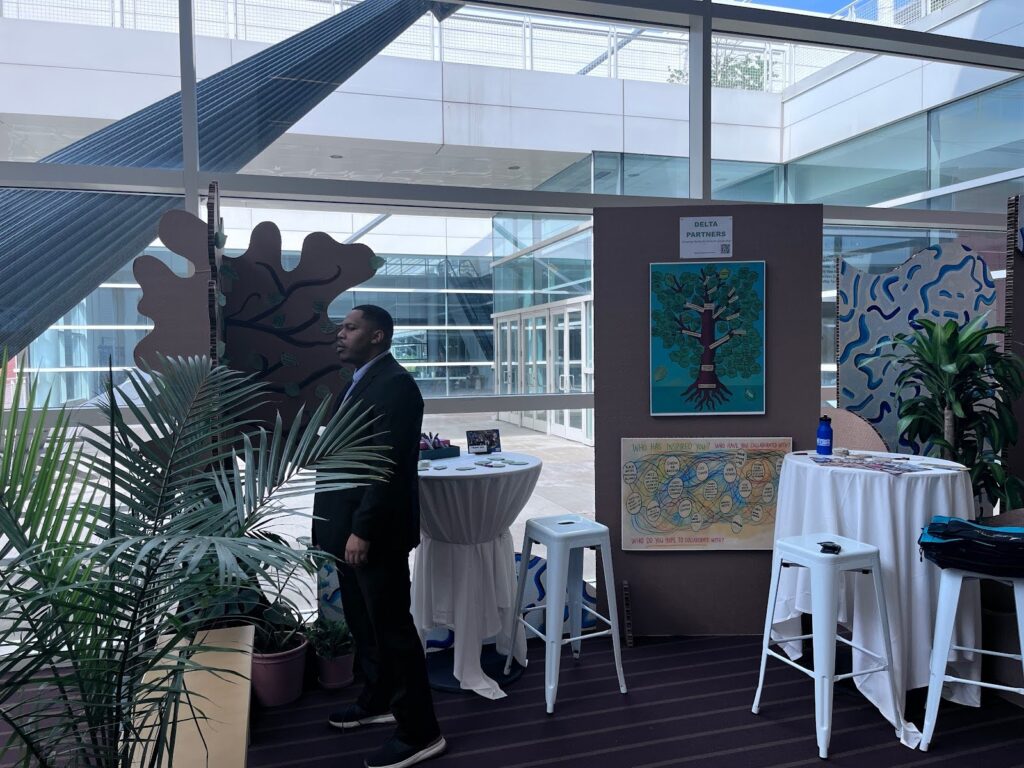
The Delta Community tree at the One Water Summit 2025
Q: You recently moved on from your role at Spring Point at the end of this summer. As you look back on your time as a funder, what advice would you give to someone just starting out as a grantmaker?
A: It’s all about relationships and building trust. Funders often have well thought out impact strategies, but our partners on the ground are constantly pivoting and dealing with the reality of the day to day micro and macro challenges. Don’t try to control the outcomes-just let the work unfold. Progress can be made by building trusted partnership, which requires funders to approach their work with humility, curiosity and a willingness to deploy their own social capital to help amplify the work. If it’s taking a while to build trust, create lots of space for your grantee partners to build community and trust among each other and demonstrate you don’t assume to have all the answers. Trust is earned from there.
Q: At its core, TFN is about building connections and finding opportunities for learning and collaboration. Do you have a favorite moment you found particularly helpful on your professional journey as a funder? Any favorite TFN memories that spark particular joy?
A: There are so many memories that spark joy, especially gathering in person with my fellow Urban Water Funders. From my first TFN convening cramming into an XL Uber in LA to our recent funders breakfast at the One Water Summit, I’ve found long-lasting friends, allies and compatriots in this network. Our convening in Austin, Texas, last year coincided with a special birthday and may or may not have prompted some hilarious dance moves.
I think I’d feel guilty about how much fun we have together if we didn’t use these deep relationships to challenge each other and help hold each other accountable to push each other to use all of our resources to drive the work forward.
When I have a blind spot in my thinking or I’m looking to build courage to try something new, I know I can count on the funders I’ve met through Urban Water Funders to help me advance the work.
Q: Speaking of sparking joy: We are all trying to figure out how to manage our personal and professional lives in these complicated times. Is there anyone or anything that’s bringing you joy in this moment — or at least some measure of sanity?
A: I took the advice shared by TFN early in 2025 to heart. I’ve been focusing on the issue I have some degree of impact on and trying my best to limit my exposure to the rest of the bad news. I try to instead read longer form news or practical advice from activists who’ve been in this work much longer. Having close allies in the funder community has helped in numerous ways. During our Climate and Water Workforce convening in mid-November, I created a 2025 survival playlist featuring lots of throwback and modern protest music (like Janel Money) and a chill vibes playlist (like Leon Bridges) that I use to center myself when I feel overwhelmed. I’ve also taken time off this summer to spend intense quality time with my kids and I have done as much floating on inner tubes in rivers and lakes as possible. This has really refueled me for the next phase of my professional journey.
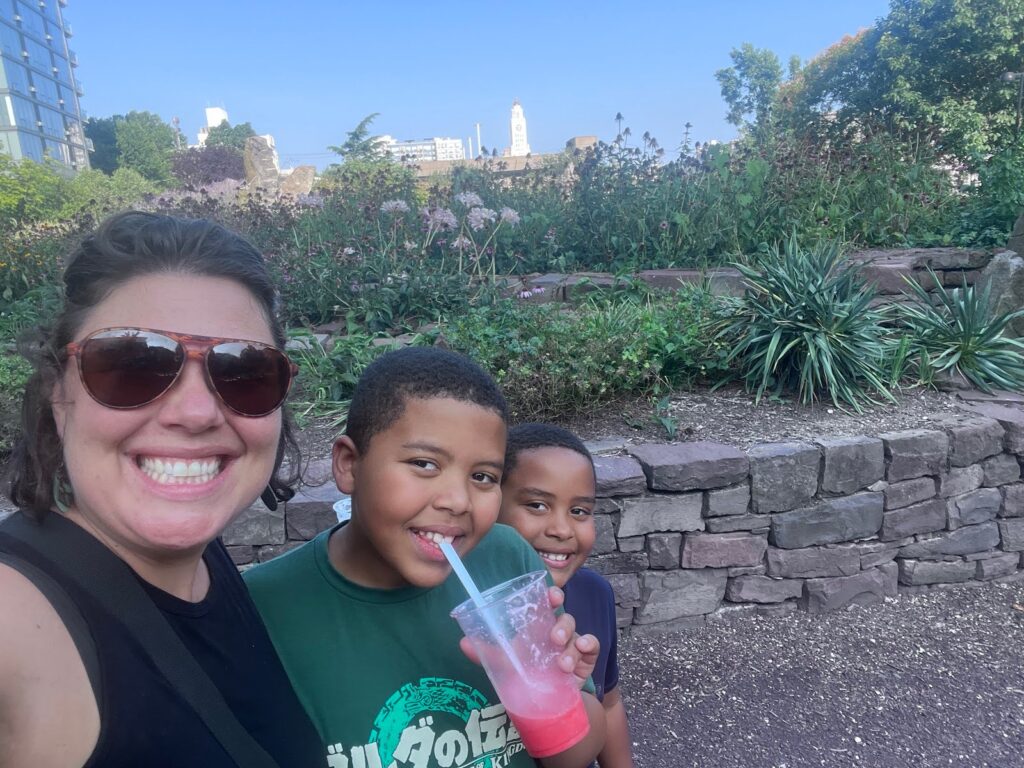
Maggie and her children in Philly this August.
Learn more about Urban Water Funders and sign up for updates on more learning opportunities. Want to connect with TFN’s Urban Water Funders in person? Save the Date for their 2026 Annual Meeting, Feb. 9-11, in Houston!
If you want to further engage Maggie in this conversation, please reach out to her at Maggie@ripplestorise.com.
Featured photo: Urban Water Funders and progressive water utility executives at the UWF-WALA breakfast, One Water Summit, November 2023. Photo courtesy of Maggie Rwakazina.