
BY Jonathan T. Reid, Program Officer, ECMC Foundation, and 2025 PLACES Fellow
As a native New Yorker, I thought I knew my state. But until recently, I had never set foot in Syracuse. That changed during a site visit with my TFN PLACES Fellowship cohort — and what I found there felt like a homecoming.
TFN’s PLACES (Professionals Learning About Community, Equity and Sustainability) Fellowship is more than a professional development program. It’s a journey into the heart of place-based philanthropy, equity-centered leadership, and systems change. Through immersive site visits, fellows explore how philanthropy can be a tool for justice, not just charity. We learn to ask deeper questions, challenge assumptions, and center community voices in our work.
Syracuse is a small(ish) city with big-city challenges and an even bigger heart. We were welcomed by the Central New York Community Foundation, whose commitment to equity is not just in their mission — it’s in their methods. Their trust-based, community-led approach to grantmaking is a model for how philanthropy can shift power, not just resources. They fund local organizations doing the work, not just those with the right connections. That distinction matters.
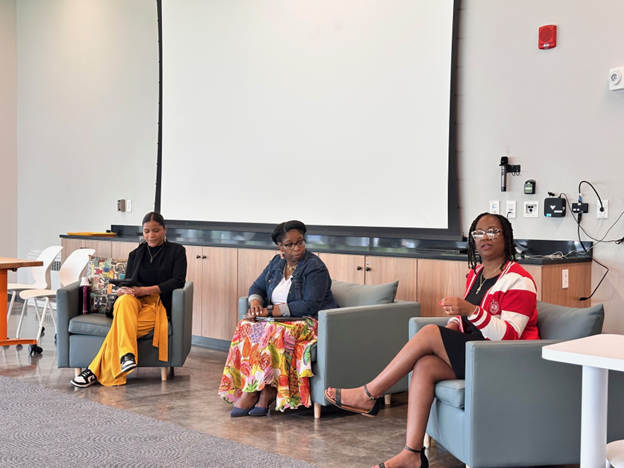
The PLACES 2025 Cohort’s site visit to Syracuse included a conversation with Black maternal health experts. From left: Rachel Johnson, Keturah Albright and Tiffany Lloyd.
One of the most inspiring stops was the Asha Laaya Farm (Farm of Hope), the agricultural branch of Deaf New American Advocacy Inc. Seeing how they are cultivating both food and community was deeply moving. Their work is a reminder that equity includes language, culture and access to land. It’s about creating accessible spaces where everyone can thrive.
We also visited the Community Folk Art Center, a vibrant hub for Black and Brown artists and cultural expression. There, and throughout our visit, we were reminded that art is not just decoration — it’s resistance, storytelling, and healing.
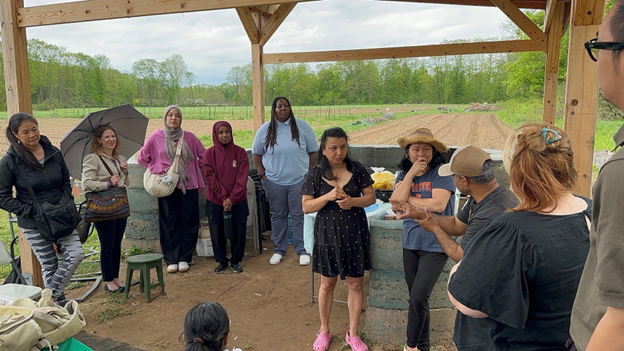
PLACES 2025 Fellows visited with the leaders of Asha Laaya Farm (Farm of Hope), a branch of Deaf New American Advocacy.
Our time with Robert Searing, education director at the Onondaga Historical Association, grounded us in the city’s complex history. From the legacy of Harriet Tubman to the Jerry Rescue, Syracuse has long been a site of resistance and refuge. These stories are not just historical footnotes — they echo the city’s present-day struggles and triumphs. The same spirit that fueled the Underground Railroad now fuels community-led efforts to address housing, education and economic justice.
Philanthropy has a role to play in this. But it must be the right role. Too often, we fund organizations based on relationships, not results. In a “word of mouth” city like Syracuse, that can reinforce inequities. We need to fund the work — not just the people we know. That means asking hard questions, having real conversations, and, as one of our speakers reminded us, learning to “ask ‘why’ five times” to get to the root cause. Surface-level solutions won’t cut it.
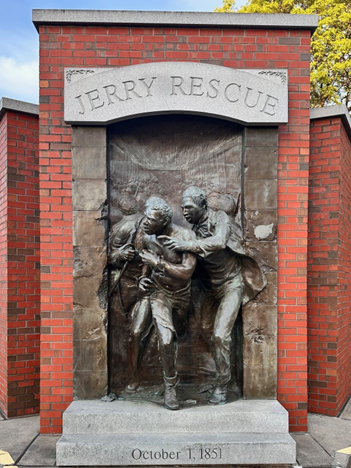
A monument to the “Jerry Rescue” in Clinton Square, Syracuse. In 1851, a crowd of abolitionists in Syracuse rose to the defense of a fugitive from slavery named William Henry, also known as “Jerry,” who had been arrested under the Fugitive Slave Act of 1850. Jerry’s arrest was met with fierce resistance from the local abolitionist community, who forcibly freed him from his captors and helped him escape to Canada.
What stood out most during our visit was the presence of what I’d call “unconditional solidarity.” It’s more than allyship — it’s a deep, ongoing commitment to standing with communities, not just for them. The organizations we met are doing the hard work of shifting power back into the hands of the people. That’s not easy. Connecting community-based organizations with systems is complex and often messy. But it starts with trust.
And trust was everywhere. I felt it in the way we were welcomed. I saw it in the relationships between funders and grantees. I heard it in the stories shared over meals and meetings. Syracuse may be new to me, but it felt like home because of the people who opened their doors and hearts to us.
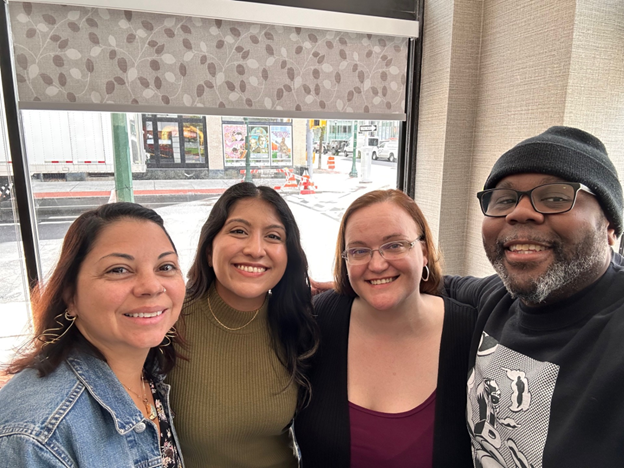
PLACES 2025 Fellows during the site visit to Syracuse. From left: Raquela Delgado Valentin, Leticia Rojas, Brandy Cramer and Jonathan T. Reid.
This visit reminded me that equity work is not about parachuting in with solutions. It’s about showing up, listening deeply, and staying in the conversation. It’s about recognizing the unequal distribution of power — and doing something about it.
As I return to my own community and work back at ECMC Foundation, I carry Syracuse with me. Its history, its people and its lessons. I’m grateful to TFN’s PLACES Fellowship for creating the space to learn, reflect and grow.
And I’m even more grateful to the people of Syracuse for showing us what it looks like to live your values out loud.
About the Author
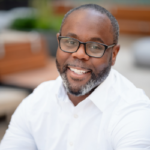
Jonathan T. Reid is a program officer at ECMC Foundation. He oversees a portfolio of grants focused on increasing the number of college students from historically underrepresented backgrounds, including low-income and first-generation populations, who pursue and attain postsecondary credentials. He is also a member of TFN’s 2025 PLACES Cohort.
Photo credits: All photos courtesy of Jonathan T. Reid.