
New Plenary Update! Susan Taylor Batten, Temi F. Bennett & Alice Y. Hom to speak at TFN's 25th Anniversary Conference
BY TFN STAFF
In today’s complex social and political landscape, bold leadership is more critical than ever — yet those who take courageous stands often face backlash, diminished resources, physical threats, and pressure to water down their work.
Those challenges can be even more pronounced for leaders of color, especially those carrying multiple identities, amid concerted efforts to undermine and attack the values, policies, and programs that support intersectional diversity, equity and inclusion.
Are foundations truly ready, willing and able to ensure leaders of color not only survive but thrive in these tumultuous times?
Join us March 17-19 in Baltimore for TFN's 25th Anniversary Conference: Be Bold Together, where we'll welcome three powerful voices to our main stage to share their lived experiences and strategies for supporting courageous leadership in the face of internal and external adversity.
Our Monday Plenary Panel: Supporting and Protecting Bold Leaders of Color will feature Susan Taylor Batten of ABFE: A Philanthropic Partnership for Black Communities, Temi F. Bennett of iF, A Foundation for Radical Possibility and Alice Y. Hom of CHANGE Philanthropy
This plenary session will explore how and why organizations and individuals should step up to ensure bold leaders of color have the resources, networks, and environments necessary to not only survive but thrive — and build stronger and more effective teams in the process.
➡️Read on to learn more about TFN25 and our Monday Plenary Panel, and be sure to check out our learning agenda for a full list of plenary presenters and other speakers.
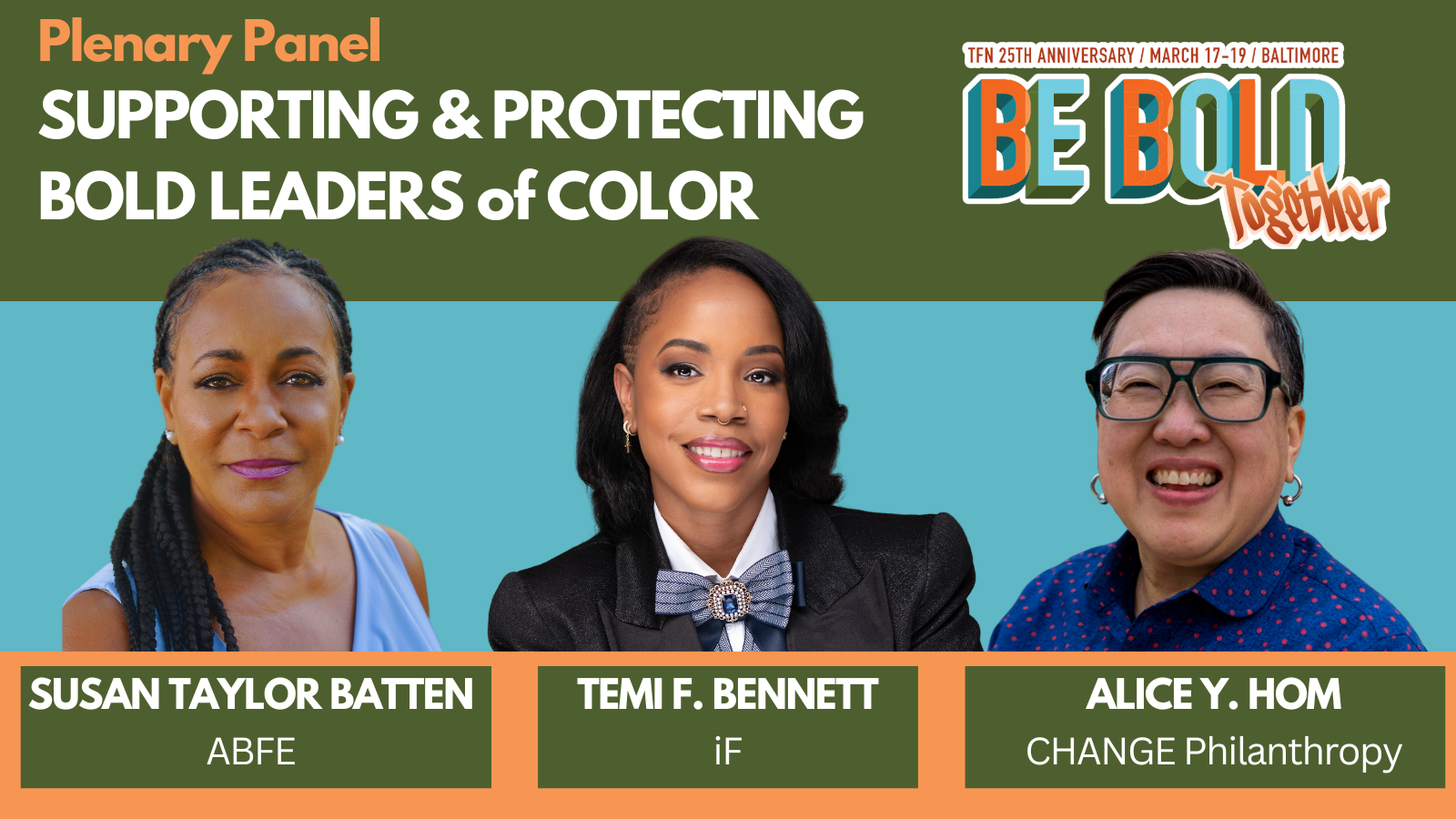
About the Panelists
Susan Taylor Batten
President & CEO
ABFE: A Philanthropic Partnership for Black Communities.
ABFE is a membership-driven philanthropic organization that champions responsive and transformative investment in Black communities. Since 2009, Taylor Batten has spearheaded ABFE's philanthropic counsel and initiatives on responsive philanthropy for Black communities, aiding foundation leaders, donors, and partners.
Bringing over 25 years of leadership in both private and public sectors to ABFE, she previously held positions with the Annie E. Casey Foundation's Community Change Initiatives Unit, at the U.S. Department of Agriculture overseeing research and evaluation of food assistance programs, and with the Government of the District of Columbia as an analyst focusing on child and family support initiatives.
She serves on the boards of the Caribbean Philanthropic Alliance and Giving Gap and regularly lectures at HBCUs about philanthropy in Black communities.
Temi F. Bennett
Co-CEO
iF, A Foundation for Radical Possibility
iF envisions a world where Black people and people of the global majority live powerfully, abundantly and beautifully in healthy, self-determined communities free of social, economic and ideological violence.
Bennett has been the driver of iF's embrace of reparations as an essential element of any effort to advance racial justice. She co-led an effort in partnership with the National Committee for Responsive Philanthropy to create the 2024 report Cracks in the Foundation: Philanthropy’s Role in Reparations for Black People in the DMV.
The report developed and executed a methodology that examines D.C.-based foundation endowments to determine if Black communities were harmed in their creation.
She also co-founded and is a member of Resourcing Radical Justice (RRJ), a funders collective that centers Black liberation as the path to a thriving greater Washington region and s a member of the policy table and the reparations working group of Movement 4 Black Lives (M4BL).
Alice Y. Hom,
Executive Director
CHANGE Philanthropy
CHANGE Philanthropy is a coalition of philanthropic networks working together to strengthen bridges across funders and communities.They seek to transform philanthropy from within by building knowledge, fostering diversity, and creating connections. Prior to joining CHANGE, Hom worked on educating funders on operationalizing racial justice with an intersectional lens as the Director of Equity and Social Justice at Northern California Grantmakers.
Hom currently serves on the board of the American LGBTQ+ Museum and on the Advisory Council for the Conscious Style Guide, a resource on inclusive, respectful and empowering language on ability/disability, age, ethnicity, gender, race, sexuality, and socioeconomic status.
Alice is a co-editor of two anthologies, Q & A: Voices from Queer Asian North America and Q & A: Queer in Asian America.
.

How we're meeting the moment at TFN's 25th Anniversary Conference in Baltimore
BY Dion Cartwright, TFN President & CEO
It’s only been a few weeks since the start of the new presidential administration.
Almost immediately, we’ve been confronted with a barrage of policy shifts designed to upend environmental protections, disrupt federal funding to essential programs and unravel decades of social and economic progress.
Many of these actions are aimed directly at already marginalized groups, threatening their physical safety and throttling access to opportunity, education, housing and healthcare.
Now more than ever, we need leaders in philanthropy willing to move resources in service of environmental, economic and racial justice.
So how can you best be of service in this moment?
By deepening your knowledge, aligning your strategies and honing your skills as effective grantmakers committed to the communities and causes you care about.
Next month, our network of funders and partners will gather in Baltimore for TFN’s 25th Anniversary Conference: Be Bold Together. Our annual conferences and other year-round learning opportunities always seek to center those most harmed by the intersecting impacts of environmental, economic and racial injustice. Those values are embedded in our network’s DNA.
But we recognize the urgency of the moment. That’s why the learning agenda for this year’s conference sets aside time to unpack political impacts on our work and identify opportunities for individual and collective action.
I'm especially thrilled that we'll welcome noted civil rights attorney and activist Maya Wiley, president and CEO of the Leadership Conference on Civil and Human Rights, as our TFN25 Closing Plenary presenter.
We also recognize that many of our members have been successfully navigating divisive political climates at the state and local levels for years — and have managed to score big wins in the process.
We’re creating space for them to share their insights and strategies in Baltimore as well.
Below are just a few highlights on our TFN25 learning agenda designed to help us navigate the road ahead.
Shared Learning and Collaboration
Given the enormity of the challenges we are facing, it’s tempting to put our own professional development on the back burner.
You may even feel a little guilty taking time to attend a conference, especially if you are working with communities feeling the immediate fallout from hateful policies or recovering from climate disasters.
But we need leaders who are emboldened, engaged and energized to meet this moment.
Regardless of your funding focus, I encourage you to venture beyond the silos and find common cause and opportunities to collaborate with other funders.
To support team learning and action-building within your organization, TFN is offering our members discounted group registration rates.
I hope you’ll join me in my hometown of Baltimore – and encourage your colleagues to do the same.
Plenary Panel: Federal Funding on the Frontlines of Climate Change
Just three years into an ambitious federal commitment to deeply invest in climate and clean energy work in ways that advance justice and equity, the ground has shifted.
Moderated by Helen Chin of the Communities First Fund, our panel discussion will feature Dr. Jalonne White-Newsome, formerly of the White House Council on Environmental Quality; Dr. Sacoby Wilson of the University of Maryland; and Meishka L. Mitchell of the Emerald Cities Collaborative.
TFN, along with our partners at the Health and Environmental Funders Network and Neighborhood Funders Group, has convened hundreds of philanthropic, grassroots, and government leaders to explore the priorities and align the strategies needed to unlock federal funds and move projects forward. These included supporting a series of regional convenings organized by Communities First.
I’m eager to learn more from our TFN25 plenary panelists about how philanthropy can step up in this moment to support community partners, secure available funding, and drive sustainable and equitable infrastructure projects.
Bolder Advocacy | Critical Conversations
Tim Mooney, senior counsel with the Bolder Advocacy Program at Alliance for Justice, will be available for free, one-on-one technical assistance sessions. He’ll answer questions and offer guidance on how foundations can engage in advocacy, as well as support their grantees’ advocacy work, without jeopardizing their tax-exempt status.
Critical Conversations
Tim will also be on hand to lead one of our Critical Conversations, which are facilitated peer-to-peer conversations for funders to explore difficult issues in a frank and confidential setting. Critical Conversation: Post-election Legal Landscape is one of several Critical Conversations on this year’s agenda that speak to this singular moment.
Visit our TFN25 Agenda for more information about our Critical Conversation facilitators, who are leading sessions focused on Post-election Organizing and Movement Building, Immigration and Migrant Support, Reimagining Philanthropy and Beyond Allyship.
Effective Narratives in an Era of Mistrust
This Skill-building Workshop looks at how political polarization and subjective “facts” threaten democracy.
Nat Kendall-Taylor of the FrameWorks Institute will lead us through how and why certain narratives succeed, offer insights into ways to reframe complex issues, and share examples that have inspired action.
Building Power for Environmental Justice in Challenging Political Climates
Join this Concurrent Session to learn strategies that groups in the heart of the fossil fuel industry are using to build power for environmental justice communities and working-class people of color.
We’ll hear from innovators supporting climate funding infrastructure and ecosystems of organizations in the South, and changemakers leading the charge for a just transition to renewable resources in oil-rich Texas.
This panel features Vanessa Toro Barragán of the Hive Fund for Climate and Gender Justice, Claudia Magana of Organized Power in Numbers, Frances Valdez of Houston in Action, and Billy Briscoe of Clean Energy Fund of Texas.
Focus on Community-Driven Solutions
From small, rural community organizations to large urban foundations, our robust network of funders reflects a broad spectrum of philanthropic work across a range of issues.
Our equity-focused learning agenda centers those most harmed by the intersecting impacts of environmental, economic and racial injustice – and highlights the philanthropic investments that support movement and power-building at the local level.
Baltimore has long been a crucible for progressive action and creative thinking, where grassroots movements and community-driven initiatives have emerged in response to systemic issues.
We’ll get a chance to learn from local changemakers making a difference across Baltimore on our popular Mobile Tours, including the positive impact local HBCUs are having on neighboring communities.
These are just a few of the sessions taking place at our 25th Anniversary Conference. You won't want to miss it!
About the Author
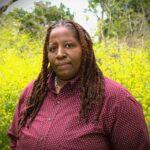
Dion Cartwright is president and CEO of The Funders Network. You can learn more about Dion on our TFN Team page.
Featured Image: Baltimore's Black Arts District | @officialblackartsdistrict
Maya Wiley, Civil Rights Attorney & Activist, Will Close Out TFN's 25th Anniversary Conference in Baltimore!
BY TFN STAFF
We are thrilled to announce that Maya Wiley, a nationally respected civil rights attorney and activist, will join us in Baltimore to close out TFN's 25th Anniversary Conference: Be Bold Together!
As we navigate an unprecedented era that threatens our democracy, undermines our civil liberties and jeopardizes the wellbeing of our communities and planet, how do we stay anchored in who we are and the work before us?
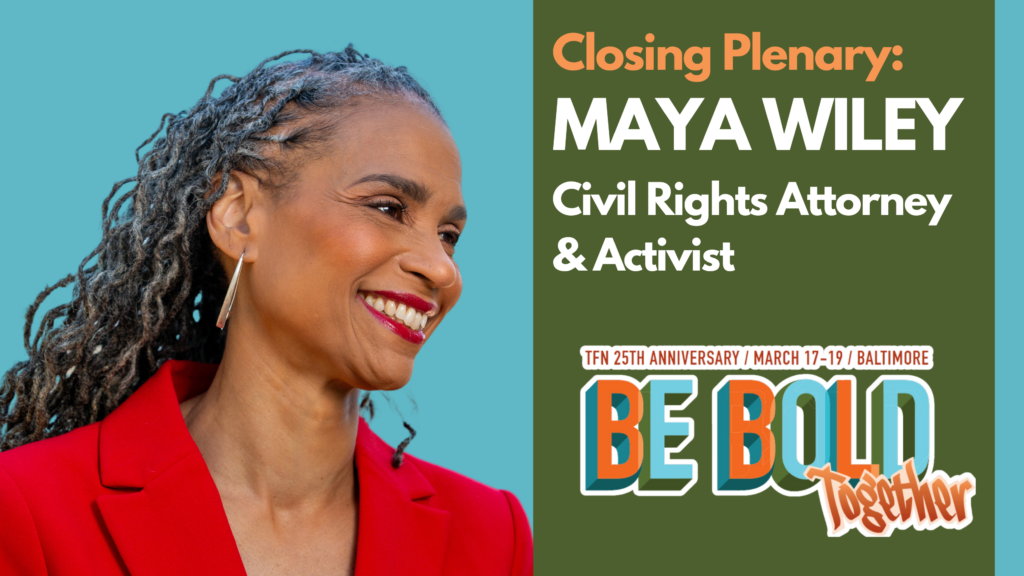 Wiley, president and CEO of The Leadership Conference on Civil & Human Rights, will share her expertise and insight in a powerful Closing Plenary focused on turning adversity into action that creates lasting change.
The Leadership Conference on Civil & Human Rights is the oldest and largest civil rights coalition in the U.S. Now in its 75th year, the coalition serves as a strategic hub for more than 200 member organizations fighting to protect, defend and expand civil rights across the U.S.
Wiley has dedicated her own life to the fights for justice, equality and fairness.
She is a former legal analyst for NBC News and MSNBC, was the first Black woman to serve as counsel to the mayor of New York City and was a senior advisor on race and poverty at the Open Society Foundations.
She also co-founded the nonprofit Center for Social Inclusion, an organization that focused on transforming structural racism into fair opportunity at the intersection of race and poverty as it relates to education, the digital divide, land use planning, the green economy, and more. (The center merged with Race Forward in 2017.)
Wiley is the author of Remember, You Are a Wiley, politically-charged memoir that draws on her upbringing in a household that prioritized activism, hope and resilience above all else: Her father was a noted leader in the civil rights and economic justice movements, work that landed him on President Nixon’s enemies list, while her mother organized third-party political platforms.
We hope you'll join us for Wiley's Closing Plenary at TFN25 as she explores how we can leverage our collective power to transcend division and meet this moment.
➡️Check out our TFN25 Anniversary Conference website to view our Learning Agenda, Accessibility and Wellbeing policies, and more.

Mobility & Access Advocacy Spotlight: Nominate a stellar transportation grantee!
Please note this blog has been updated with a new deadline for submissions.
BY Martha Roskowski, Coordinator for TFN’s Mobility and Access Collaborative
Nonprofit leaders across the country are strategizing, organizing and mobilizing for better transit service, safer walking and biking, and fewer highway expansions. Their work supports marginalized communities and builds more equitable and sustainable systems.
Are you supporting any of these stellar grantees through your grantmaking? If so, let us know!
 TFN’s Mobility and Access Collaborative is launching an Advocacy Spotlight series that will lift up nonprofit grantees making an impact in their communities and beyond.
If you’d like to nominate a grantee for this series, fill out this short online form. The deadline to submit has been extended to March 31, 2025.
We’ll feature the grantee on TFN’s social media platforms and other communications platforms as part of our commitment to amplifying community-led sustainability solutions and building the field of philanthropy through shared learning.
“Local and grassroots advocates are hard at work fighting for more abundant public transportation systems that form the bedrock of safe, healthy, and vibrant communities,” said Chris Van Eyken, director of research and policy for TransitCenter and a member of the Mobility and Access Collaborative’s Design Committee.
“This series will highlight how their dedicated efforts have led to transportation investments that connect communities to economic opportunities and essential services, improve public health outcomes, and reduce the environmental impacts of transportation.”
We’ll share the Advocacy Spotlights starting in the spring. If your nominated grantee is selected for this series, we’ll reach out to you and the grantee group to confirm additional details.
Questions or suggestions? Please contact Martha Roskowski martha@fundersnetwork.org
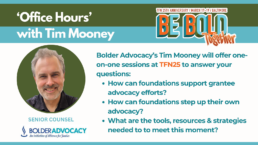
Connect with Bolder Advocacy Senior Counsel Tim Mooney at TFN's 25th Anniversary Conference in Baltimore!
In these challenging times, many funders are eager to support their grantees’ advocacy and movement-building work — or step up their own organization’s advocacy efforts.
These are key strategies in the philanthropy toolbox.
But we know there is a lot of confusion about what’s allowed and what’s effective. That’s why we’re proud to partner with Alliance for Justice’s Bolder Advocacy program for TFN’s 25th Anniversary Conference: Be Bold Together, March 17-19 in Baltimore.
TFN25 will feature Tim Mooney, senior counsel with Bolder Advocacy, as our on-site “Office Hours” resource for one-on-one technical assistance sessions.
Bolder Advocacy provides training, technical assistance, tools, and resources to help foundations (and their grantees) maximize their impact without running afoul of the rules governing nonprofits and charitable organizations.
We’re offering this resource as part of TFN’s ongoing commitment to help funders navigate the road ahead with a forward-looking eye towards strategic approaches at the federal, state, regional, and local levels.
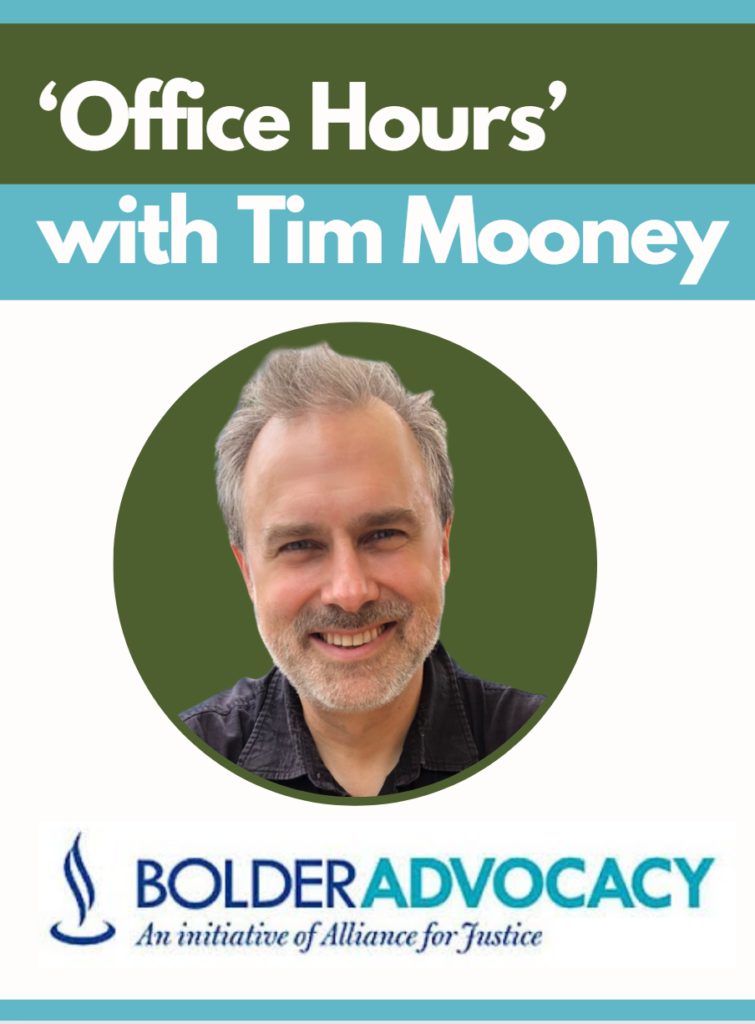 Tim will be available for appointments during designated windows throughout the conference to:
- Answer questions about how private and public foundations can support grantees’ advocacy efforts;
- Offer guidance on how foundations can engage in advocacy themselves;
- Share tools and resources;
- And strategize about what this moment calls for.
Registered attendees can sign up for these short, private technical assistance sessions through our Swapcard digital platform/conference app.
Tim also will co-facilitate Critical Conversation: Post-election Legal Landscape with Abby Levine, associate general counsel at the Robert Wood Johnson Foundation (and formerly of Bolder Advocacy), on Wednesday morning, March 19.
As senior counsel at Bolder Advocacy, Tim provides one-on-one technical assistance for nonprofit advocates, teaches nonprofit and election law workshops and writes on these issues for Bolder Advocacy publications.
(Tim and his colleagues also share their legal wisdom on the Bolder Advocacy podcast, Rules of the Game.)
He began his legal career as co-founder and counsel for Columbia Riverkeeper, working to protect and restore the largest watershed in the Pacific Northwest. He has also served as senior counsel at Citizens for Responsibility and Ethics in Washington.
As we embrace strategies, tools and tactics to Be Bold Together, we’re thrilled to continue our partnership with the team at Alliance for Justice.
We first offered similar by-appointment resources with Bolder Advocacy at our 2017 Annual Conference in the Twin Cities. We’ve been grateful to have featured their insight and expertise on a number of webinars and learning opportunities in recent years.
Please visit our TFN25 website to see our full agenda as well as speaker updates and other highlights.
 Photo by tookapic is licensed under CC BY-NC-SA
Registration Now Open! TFN's 25th Anniversary Conference: Be Bold Together | March 16-17, 2025
Registration is now open for TFN's 25th Anniversary Conference: Be Bold Together, which takes place March 17-19 in Baltimore, Md.!
Below is a message from our TFN25 Conference Co-chairs, Thomasina (Tomi) Hiers of The Annie E. Casey Foundation, Danista E. Hunte of the Maryland Philanthropy Network and Kacey Wetzel of the Chesapeake Bay Trust.
 We’re thrilled The Funders Network is celebrating its 25th Anniversary Conference in Baltimore on March 17-19.
Throughout its history, TFN has brought funders together to build relationships, align strategies and inspire action.
Opportunities to connect and collaborate have always been essential to our work.
But we know that in the coming months, many of us will be wrestling with how to channel philanthropic resources – and our own mental and physical energies – to best serve the people and places we care for.
How can we effectively work to address escalating climate crises, overcome barriers to opportunity and safeguard the wellbeing of vulnerable communities, while also navigating shifting political terrain?
Now, perhaps more than ever, is the time to lean into TFN’s incredible community of mission-aligned funders, partners and allies.
What We're Excited About
TFN’s 25th Anniversary Conference will bring together hundreds of grantmakers representing a broad spectrum of place-based philanthropy, from small, rural community organizations to large urban foundations.
Our equity-centered learning agenda will offer practical skill-building sessions, thought-provoking breakouts and compelling plenary speakers.
We’ll also create space for generative conversations that unpack critical topics, including the post-election legal landscape and movement-building opportunities.
Baltimore has a rich history of resilience and innovation in the face of systemic challenges. We’re excited about the chance to learn from people driving meaningful change in neighborhoods across Baltimore during TFN’s signature Mobile Workshops.
And we can’t wait to celebrate our culinary heritage at the Eat Here! reception in Baltimore’s Remington neighborhood, a favorite destination for local artists, nonprofits and innovators.
TFN’s Anniversary Conference will also explore the power of media and the arts to create narrative change and social impact.
We’ll showcase local performers in our Artistic Interludes and Opening Plenary by Wombworks Productions, and offer a thoughtful documentary – and filmmaker Q&A – at our popular TFN @ the Movies event.
Join Us!
Our 25th Anniversary theme — Be Bold Together — is a call to all of us to embrace courageous action and meaningful collaboration that helps unlock environmental, economic and racial justice.
It’s also a reminder about the power of community, of finding your people, and knowing that no one is alone in this work.
We are all in this together.
So whether you’re a familiar face at TFN events or a newcomer curious about our network, we hope you’ll join us to share strategies, insight and motivation for the road ahead.
We look forward to being bold – together – in Baltimore!
With gratitude,
TFN 25th Anniversary Conference Co-chairs
 Thomasina (Tomi) Hiers
Vice President, Center for Civic Sites and Community Change
The Annie E. Casey Foundation
 Danista E. Hunte
President & CEO
Maryland Philanthropy Network
 Kacey Wetzel
Vice President of Programs
Chesapeake Bay Trust
➡️ Learn nore about TFN's 25th Anniversary Conference: Be Bold Together, including Agenda Highlights, Accessibility & Wellbeing policies and Childcare options., here.
TFN's 25th Anniversary: Help us continue our mission and build our network!
BY TFN Staff
This giving season, join us in celebrating TFN’s 25th Anniversary — and help advance and support our mission for the future!
Whether it’s through an individual donation or as an organizational sponsor of our 25th Anniversary Conference in Baltimore this March, your contribution will help us sustain our network and live our values.
The collective power of our funders, partners and allies has been at the heart of TFN since our inception, creating opportunities for shared learning, collaboration and action.
TFN works to break down silos and connect funders with diverse areas of focus, educating and inspiring the philanthropic sector to help create communities and regions that are sustainable, prosperous, healthy and just for all people.
We know the coming year will likely mean deep reflection and difficult conversations as we face an increasingly complicated political and cultural landscape.
We’re committed to helping our community navigate the road ahead through our equity-centered learning agendas, issue-based and funder-led working groups, and signature offerings like our annual conference and PLACES Fellowship.
Below are some opportunities to support our 25th Anniversary campaign and other TFN 2025 priorities.
Individual Donations
TFN 25th Anniversary: Be Bold Together
 Advance TFN’s mission to activate and support bold philanthropic leadership.
Your contribution helps sustain our network and provide issue-based programming, opportunities to connect and collaborate, and platforms to share strategies and resources.
PLACES 15th Anniversary
 More than 200 philanthropy professionals have completed TFN’s equity-centered PLACES Fellowship, becoming agents of change across the sector.
Help support and advance the program, including coaching and curricula for both Fellows and Alums, travel sponsorships, engagement opportunities, and complimentary conference registration for current PLACES Fellows.
Beyond a Land Acknowledgement
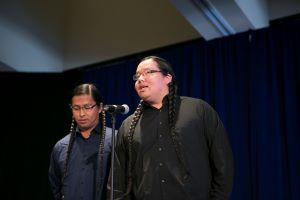 Only a sliver or philanthropic dollars go to support Native tribal communities or Indigenous-led organizations. In 2024, TFN adopted a new land acknowledgement practice: For all in-person gatherings, TFN also makes a financial contribution to a local organization led by and serving Native American/Indigenous communities. At our 25th Anniversary Conference in 2025, we will acknowledge and contribute to a Baltimore-based organization as part of this commitment.
Support Local Vendors & Food Systems
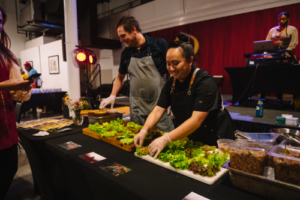 TFN’s Eat Here! culinary reception is a popular fixture at our annual conferences, celebrating the rich tapestry of the host community’s culinary scene and agricultural heritage. Your contribution will help support local chefs and vendors, notably minority- and women-owned businesses at our 25th Anniversary Conference in Baltimore.
Organizational Sponsors
TFN offers mission- and issue-aligned opportunities to sponsor our 25th Anniversary Conference: Be Bold Together, which takes place March 17-19 in Baltimore.
Our learning agenda offers skill-building workshops, deep-dive strategy sessions and opportunities to forge new connections — enriching funders, their teams, and the broader philanthropic sector.
We’re also committed to equitable compensation for all vendors, artists and non-profit speakers, and sustainable practices whenever possible.
➡️Click on the sponsor deck below to learn more about sponsor levels and benefits.
➡️ Ready to become a sponsor? Please fill out this Sponsorship Form to sign on today!
Become a Member
Are you hoping to increase the impact of your grantmaking, share best strategies, and find opportunities for meaningful collaboration?
Become a TFN member and your organization will join more than 130 foundations across the U.S. and Canada committed to creating communities and regions that are sustainable, prosperous and equitable.
➡️Read our Membership At a Glance learn more!
Fellowships Address Barriers for People of Color in the Climate Field | Cross-post
The Funders Network is committed to sharing the stories and strategies of our members, partners and others in the philanthropic sector working to create more sustainable, prosperous and equitable communities.
Today, we’re sharing a recent blog post by Barr Foundation's Emily Sidla, climate program manager, and Rory Neuner, senior learning officer.
BY Emily Sidla and Rory Neuner, Barr Foundation
At the heart of Barr’s Climate program is the belief that achieving our ambitious climate goals requires building an inclusive, multi-racial, and equity-centered movement. How do we make this a reality? One key approach is to expand career pathways in the climate field. People of color face systemic barriers to entering and advancing in the field, and remain under-represented. According to the 2023 Green 2.0 Report, people of color account for only 38% of full-time staff and 31.5% of individuals responsible for leading* non-profit climate and environmental organizations.
In recent years, we’ve invested in new approaches to building a more diverse cadre of leaders within the climate movement. One of our strategies is supporting fellowships and leadership development programs that create pathways for people of color to enter and advance in the field. We’ve identified a gap in substantive, longer-term programs focused on early career development and leadership growth for young professionals. Since 2021, Barr’s Climate Program has funded three early career fellowship programs in the Northeast: the RAY fellowship, the Racial Equity in Policy and Planning Fellowship (REPP), and the Young Climate Leaders of Color/Young Black Climate Leaders programs. These programs recruit individuals committed to the values of equity and inclusion, offering access to mentorship, in-person and virtual retreats, peer gatherings, professional development, networking opportunities and skill building sessions. To date, 16 fellows have been supported with Barr funding.
Three years in, we sought to better understand the experiences of both the fellows and the staff running the fellowship programs. To achieve this, we partnered with the consulting firm Public Profit on a learning and evaluation project. Our goal was to listen to the fellows and the staff, and identify opportunities for greater impact. We gathered data through surveys and focus groups with the fellows, as well as focus groups with program staff. Participation was entirely voluntary—our aim was to gather as much feedback as possible without imposing an additional burden on participants. We were encouraged to see that 80% chose to opt in, including to the more time-intensive focus groups.
What We Heard
The evaluation highlighted three key findings:
1. The barriers to entering the climate and environment field are substantial.
When asked about the barriers they faced before their fellowships, fellows reported a steep climb into the field, confirming our assumptions and providing greater clarity on where to focus our efforts. Fellows identified several top barriers:
- The most common challenge was a lack of personal connections within the climate and environmental field, with 67% of fellows citing this issue. Additionally, 60% reported lacking contacts who could guide them on how to enter and succeed in the field.
- A second major barrier was financial: Sixty percent of fellows noted that wages in climate and environmental roles were lower than comparable positions in other industries. Furthermore, many jobs/internships were unpaid or paid inadequately, considering the skills and experience required. High living costs in locations where jobs/internships are available also made these opportunities financially inaccessible (60%). Difficulty finding and applying for jobs/internships was another common challenge (60%).
- A third area of concern was workplace culture. Fellows described feeling discouraged by environments where they didn’t see others with similar personal backgrounds or experiences (53%), where organizational values didn’t align with their own (60%), or where they felt isolated or unwelcome (40%).
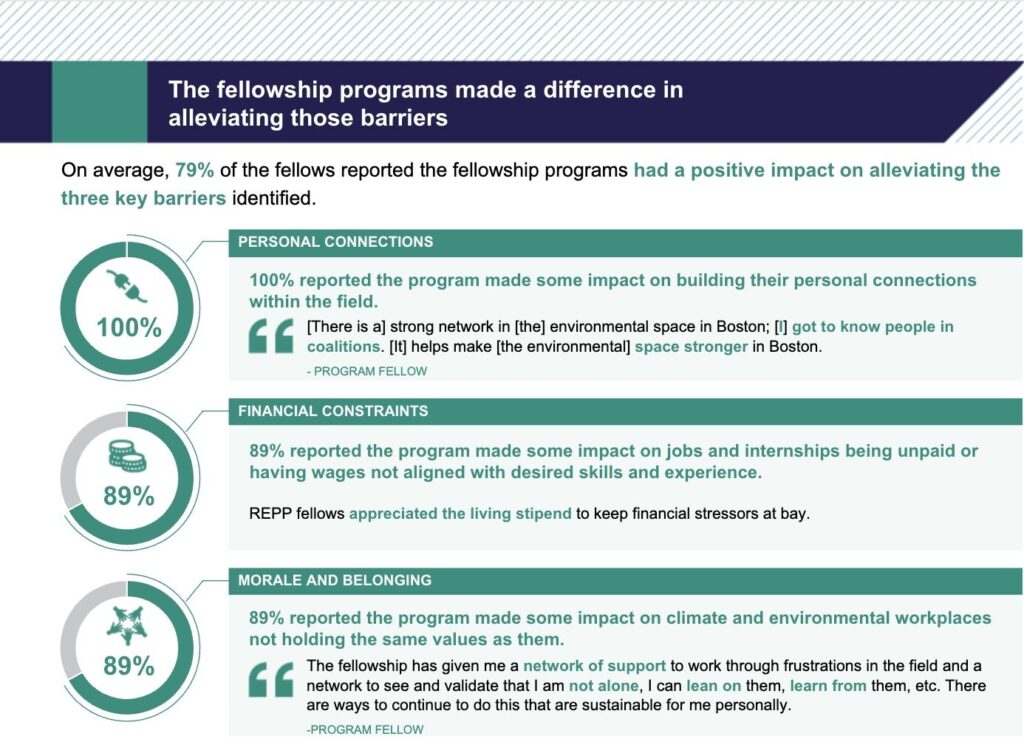
2. These programs made a meaningful difference in alleviating some of those barriers.
Most fellows reported that the relationship-building and networking opportunities provided by their fellowship programs exceeded their expectations. We were pleased to learn about the overall positive impacts and appreciated the fellows’ thoughtful reflections on areas for improvement. Fellows shared that the chance to form deeper relationships and expand their peer and alumni networks was particularly valuable. Many also noted that the programs helped to alleviate some of the financial barriers and improved feelings of morale and belonging in the workplace.
3. There’s a need for even more connections.
Building connections and networks within the climate and environmental field was top priority for fellows. They expressed a desire for more opportunities to connect with others in their programs and to form relationships with local leaders in the field. Fellows indicated they would be more likely to recommend their programs to peers if there were additional chances for networking and learning from experienced professionals. Both fellows and program staff suggested that Barr could play an important role as a convener, by hosting networking events and facilitating connections.
Next Steps for Barr: Meaning Making from Feedback
The feedback we received from the surveys and focus groups illustrates the positive impact these fellowships have had in supporting early-career leaders in the climate and environmental field. It also underscores the value of inclusive listening—engaging those closest to the work, such as the fellows – as a powerful way for funders to inform and shape future actions. Beyond funding programs like these, we heard that Barr can play an important role as a convener, helping to connect individuals in the field who are working to advance climate solutions. In response, we’re planning targeted steps to expand the Climate Program’s role in organizing convenings and networking, particularly for young and emerging leaders of color.
While the magnitude of the barriers to entering the field is discouraging, these findings bring enormous value by lifting up the top barriers and showing us and others in the field what should be prioritized. They also reinforce the importance of the organizing, policy advocacy, and movement building work supported by our Clean Energy, Mobility, and Climate Resilience strategies which aim to drive long-term, systemic progress and reduce barriers.
At Barr, we remain committed to racial equity, recognizing that we all play a part in building a diverse, inclusive, and just climate movement. First and foremost, we thank the fellows who participated in this evaluation—your honest feedback has been invaluable, and we are proud of your leadership and vision. We also appreciate the program staff for enriching our learning process. To funders and climate organizations, we can all do better by listening more closely to those impacted by our work and using these insights to make more informed and equitable decisions. We hope this work inspires others to support leadership fellowships and address barriers in the field, fostering a truly inclusive and multicultural environment through thoughtful policies, practices, and workplace culture. For those already funding these efforts, we look forward to sharing insights and collaborating to deepen our collective impact.
➡️To read the original post and access the full summary of the Barr Foundation's evaluation findings, click here.
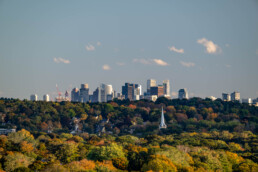
"Boston and Woburn" by donovan_terry is licensed under CC BY-NC

We Stand Boldly in Our Commitments: Election reflections & resources from TFN's Dion Cartwright
BY Dion Cartwright, TFN President & CEO
We are only four days away from a high-stakes presidential election, with more than 60 million ballots already cast by early and mail-in voting.
The outcome may come down to a razor-thin margin and we may not know the final results for days or even weeks after Election Day, if polls and pundits are to be believed.
Uncertainty can be a heavy weight to bear, even for optimistic folks like myself.
I am certain about this, though: Philanthropy, at its best and boldest, has a moral mandate to unlock the resources that will move us closer to racial, environmental and economic justice – regardless of who is in office.
As we head into the final stretch of this presidential election, I wanted to share these reflections and resources with TFN’s community of funders, partners and allies.
The Road Ahead
TFN is committed to helping our members and the broader philanthropic sector navigate the post-election landscape.
Over the past year, we’ve been unpacking political impacts on our work, including partisan efforts that threaten historic levels of climate investment and concerted efforts to roll back decades of progress on social justice issues.
Looking forward, our funder-led working groups will be holding peer learning calls and funder briefings to process the impact a new administration will have on our communities and climate. We are creating space at our 25th Anniversary Conference in Baltimore to further share insights and strategies.
TFN is co-sponsoring two post-election webinars organized by the Center for Disaster Philanthropy and Grantmakers Concerned with Immigrants and Refugees. Smart Growth California, a TFN initiative, is also partnering with SoCal Grantmakers for a hybrid virtual/in-person convening later this month to explore the impact election results could have on the environment.
Support Those Doing the Work
As the head of a network focused on creating more sustainable, prosperous and just communities, I know that we’ll have a steeper hill to climb depending on who sits in the Oval Office.
But I also know that our journey toward justice began long before this election cycle, and will continue long after.
And the hate-filled rhetoric targeting immigrants, trans kids, women of color and other marginalized groups?
While those disgusting comments and so-called “jokes” have been trumpeted and celebrated by candidates up and down the ballot, they aren’t just confined to the campaign trail.
Those harmful words can be heard on our social media feeds, in our kids’ classrooms, at our places of work and worship. Maybe even across our own kitchen tables.
They’re not new to those of us who have been hearing them our whole lives – just louder.
That’s why it’s important to acknowledge and support those working toward meaningful change, from grassroots movement leaders to bold voices in philanthropy calling out injustices in the sector.
We see you and stand by you.
And to those foundations that are considering pulling back on their equity commitments, or paring down their internal equity practices: I encourage you to reconsider, and implore you not to sacrifice our shared struggle in the name of political pragmatism or fear. Stand boldly with us in our commitments.
Our Commitment to Racial Equity
TFN will continue to center racial equity in all that we do. We remain steadfast in our belief that we cannot address the escalating climate crisis, widening wealth gap or stark inequities in healthcare access – among other critical issues – without addressing systemic racial injustice.
We are ten toes down for diversity, equity and inclusion, regardless of the pushback from those who want to undermine or water down these values.
What We Ask of You
- VOTE! If you didn’t make it to early voting, please show up on Nov. 5. It’s an honor and a duty that many of our ancestors fought for.
- Prepare for post-election action. Support grassroots organizations that are ready to respond to challenges facing marginalized and racialized communities. Host conversations with grantees and partners on the election's impact. Fund legal services and strategies to help inform policy and advocacy efforts, and support narrative change by uplifting the stories of those most impacted.
- Support advocacy efforts that defend the rights of immigrants, the LGBTQIA+ community and those fighting for reproductive justice. There are many worthy organizations, but I’ll lift up fellow philanthropy serving networks such as Grantmakers Concerned with Immigrants and Refugees, Funders for LGBTQ Issues and Funders for Reproductive Equity.
- Flex your own advocacy muscles. There are opportunities to impact policies at the local, state and federal level beyond presidential elections. TFN has worked with Alliance for Justice’s Bolder Advocacy to provide resources to our network. Their website has additional resources for foundations looking to advance their missions through policy advocacy.
- Invest in equity-focused professional development for your team, your board – and yourself. Philanthropy needs leaders who have the understanding and skills to embed equity into their programmatic, grantmaking and community engagement practices. TFN’s cross-cutting approach to racial equity informs our internal and external practices, including our working groups, virtual learning opportunities and in-person events. Please reach out to me or Vice President of Programs and Partnerships Ann Fowler Wallace if you’d like to learn more.
- Let us know what you’re doing. If your organization has an election-related statement, resource or learning opportunity, send it our way. Please reach out to TFN Senior Communications Director Tere Figueras Negrete to be considered for our round-up of post-election resources.
And finally, I encourage each of you in the coming days to set aside time for something – or someone – that brings you joy.
Like Audre Lorde wrote: Caring for myself is not self-indulgence, it is self-preservation, and that is an act of political warfare.
Be well and take care.
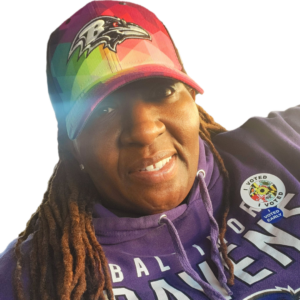
Rocking Baltimore pride — and my early voting sticker.
Additional Resources
Imagining 2025: What’s next for disaster philanthropy?
Nov. 14 | 1-2 p.m. ET
Webinar
This Center for Disaster Philanthropy webinar is co-sponsored by TFN, Alliance Magazine, Philanthropy New York and United Philanthropy Forum.
The Election and Its Impact on The Environment
Nov. 15 | 10:30 a.m.-1 p.m. PT
Hybrid virtual/in-person
This SoCal Grantmakers event is presented in partnership with Smart Growth California, a TFN initiative.
The 2024 Election and the Path Ahead
Nov. 19 | 12:30-2 p.m. ET
Webinar
This webinar is organized by Grantmakers Concerned with Immigrants and Refugees and is co-sponsored by TFN, Philanthropy New York, Council of New Jersey Grantmakers, Forefront, and Funders Together to End Homelessness.
Decision '24 Post-Election Briefing: Debrief + Sector Outlook
Nov. 20 | 12- 1:15 p.m. ET
Webinar
To help PSOs and their foundation members make sense of it all, join United Philanthropy Forum for our special Decision ’24 Post-Election Webinar, where we will analyze the results, discuss potential policy shifts, and look ahead to what’s on the horizon for the coming year.
This Much We Know
Blog Post | Barr Foundation
President and Trustee Jim Canales on how the Barr Foundation will meet this moment.
For an updated list of post-election statements, resources and events, click here.
Featured photo by Ronile | CC BY-NC-SA
Next 100 Years Challenge Update: Importance of Heat Data Collection | Cross Post
The Funders Network is committed to sharing the stories and strategies of our members, partners and others in the philanthropic sector working to create more sustainable, prosperous and equitable communities.
Today, we’re sharing a recent blog post from Isabel Barrios of the Greater New Orleans Foundation and a member of TFN's Board of Directors.
BY Isabel Barrios, Senior Program Officer, Greater New Orleans Foundation
When was the last time you were at a playground or a bus stop on a hot day? As it turns out, depending on the materials used and availability of shade nearby, these places can be dangerously hot and unsafe on hot days. Jason Neville, Executive Director of the Lafitte Greenway Partnership (formerly Friends of Lafitte Greenway,) recently discovered a nearly 50̊ temperature difference between a sun-exposed playground surface (127̊ ) and a nearby shaded grassy spot (80̊ ) with a user-friendly Forward Looking Infrared (FLIR) camera.
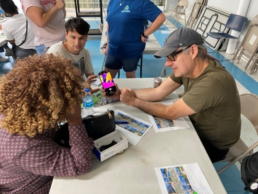
On Saturday, September 28, the Greater New Orleans Foundation’s Next 100 Years Challenge participants were hosted by the Lafitte Greenway Partnership for a heat data collection training at the Sojourner Truth Center in Mid-City. Trainers, Janice Barnes and Leo Temko of Climate Adaptation Partners, focused on the hazard that heat presents for communities and how to use heat data to make outdoor spaces safer. Participants learned about why it is important to address heat, how to collect heat data using FLIR cameras, and how to use the data collected to create cooler spaces. After some practice, participants teamed up and took the FLIR cameras outside for a test run.
The Foundation launched the Next 100 Years Challenge in celebration of our centennial year to inspire great ideas for resilient infrastructure projects, including nature-based solutions, that will reduce the threat from storms and other disasters and which can attract federal and state funds for their construction.
➡️Read Isabel's full post to learn more about this event and GNOF's $1.2 million in awards for projects focused on community-centered and cost-effective infrastructure improvements.
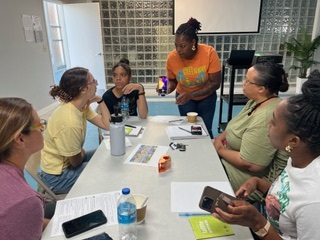
Lafitte Greenway Partnership for a heat data collection training at the Sojourner Truth Center.
Photo credits: Greater New Orleans Foundation.