
BY Martha Roskowski, Program Coordinator, TFN’s Mobility and Access Collaborative
I made a new sign for the last No Kings march. I thought about a lot of possibilities including anti-ICE, anti-fascism, anti-racism, pro-democracy, pro-science and pro-trans rights. Instead, I opted for a message to my fellow protestors. I chopped up a cardboard box, borrowed paints from my kid’s desk before they headed off to college, and got out the duct tape.
My sign said, “Stay Strong, my friends.”

I tucked it into my bike pannier, met up with a neighbor and rode into downtown Boulder to join thousands from my community.
Several people commented on my sign. One man said it was one of the most important messages of the day. A woman dressed as the Statue of Liberty told me, “Every time I put on this costume and drive down here, it makes me angry that I have to spend my time this way.”
I agree.
I am angry at what the current administration is doing to our world, my country, my state and my community. I am tired of going to protests, door-knocking, writing letters and calling my members of Congress.
I am also scared.
Scared of what’s happening in our country, but also on a more personal level — scared of going to protests for fear of ICE or police violence. Scared of speaking up online for fear of retribution, of being identified via cameras and other surveillance, of being arrested because we have jobs and families. Scared of our non-profits and foundations being targeted.
At The Funders Network’s 25th Anniversary Conference in Baltimore last year, Maya Wiley of the Leadership Conference on Civil and Human Rights reminded us that the heroes of the civil rights movement were ordinary people. They didn’t wait for leaders to organize them. They stood up and did it themselves. They were tired and scared, yet they acted anyway.
That idea stays with me in my work with The Funders Network, where we think about how philanthropy can support the conditions for that kind of collective action.
I recently traveled to Alabama to visit Birmingham, Montgomery and Selma — three of the most consequential cities in the Civil Rights movement. I thought I knew something about this era and Martin Luther King, Rosa Parks, the Freedom Riders and the church bombing that killed four little girls in Birmingham.
But I was humbled by my visit, especially to the Legacy Sites in Montgomery, established by Bryan Stevenson and the Equal Justice Initiative.
Every American should visit, especially white women like me whose lineage is complicit in this history. The trio of sites – a museum, sculpture garden, and memorial – do a exceptional job of connecting the arc of history: from kidnappings in Africa and slave ships crossing the Atlantic to the domestic slave trade, where where one of the greatest fears was family separation.
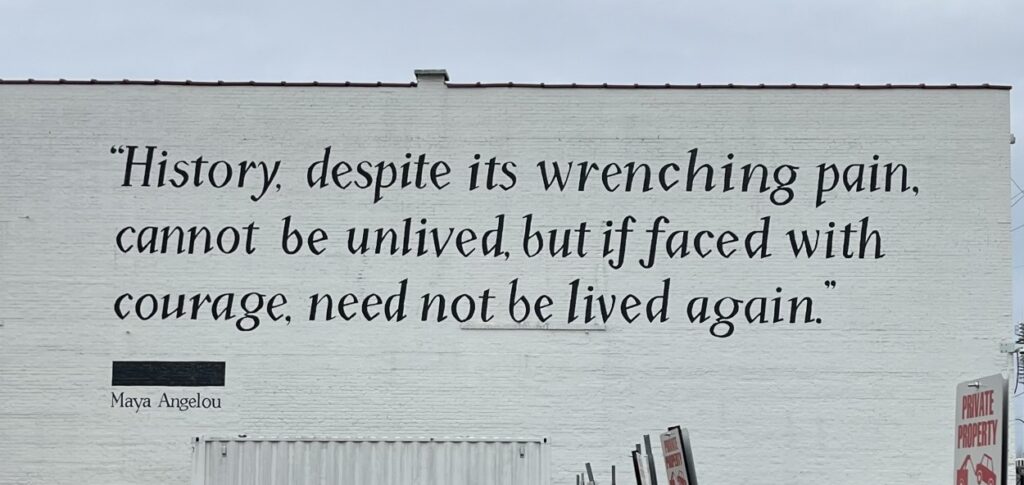
They trace the story through the brief, fragile years of emancipation, followed by the terror of lynching, when any Black person who spoke up, organized or was thought to break racial rules risked being killed by a white mob. The story continues through the grinding weight of segregation, the courage of civil rights heroes, and into the present day, with police violence and a prison-industrial system that incarcerates Black Americans at more than five times the rate as white Americans.
As I reflect on both this civil rights history and the horror of today’s governmental targeting, cutbacks and cruelty, I realize that this is just the latest chapter in an ongoing story. A colleague of color recently said that for many Black people, the current administration feels less like a shocking new reality and more like a continuation of what they have endured for generations.
So: welcome to the club.
The Legacy Sites in Montgomery, Selma, and Birmingham tell the stories of people who were taunted, bloodied, attacked by dogs and arrested for standing up for their rights. They were afraid, and still they got back up and marched, organized and protested again and again.
I hope we can be as brave today.
About the Author
 Martha Roskowski is the founder of Further Strategies, a consulting firm based in Boulder, Colorado, and serves as the program coordinator for TFN’s Mobility and Access Collaborative, where she helps organize foundations around equitable transportation.
She brings deep experience across the mobility and transportation policy world, with a career spanning local, state, and national efforts to make streets safer and more accessible.